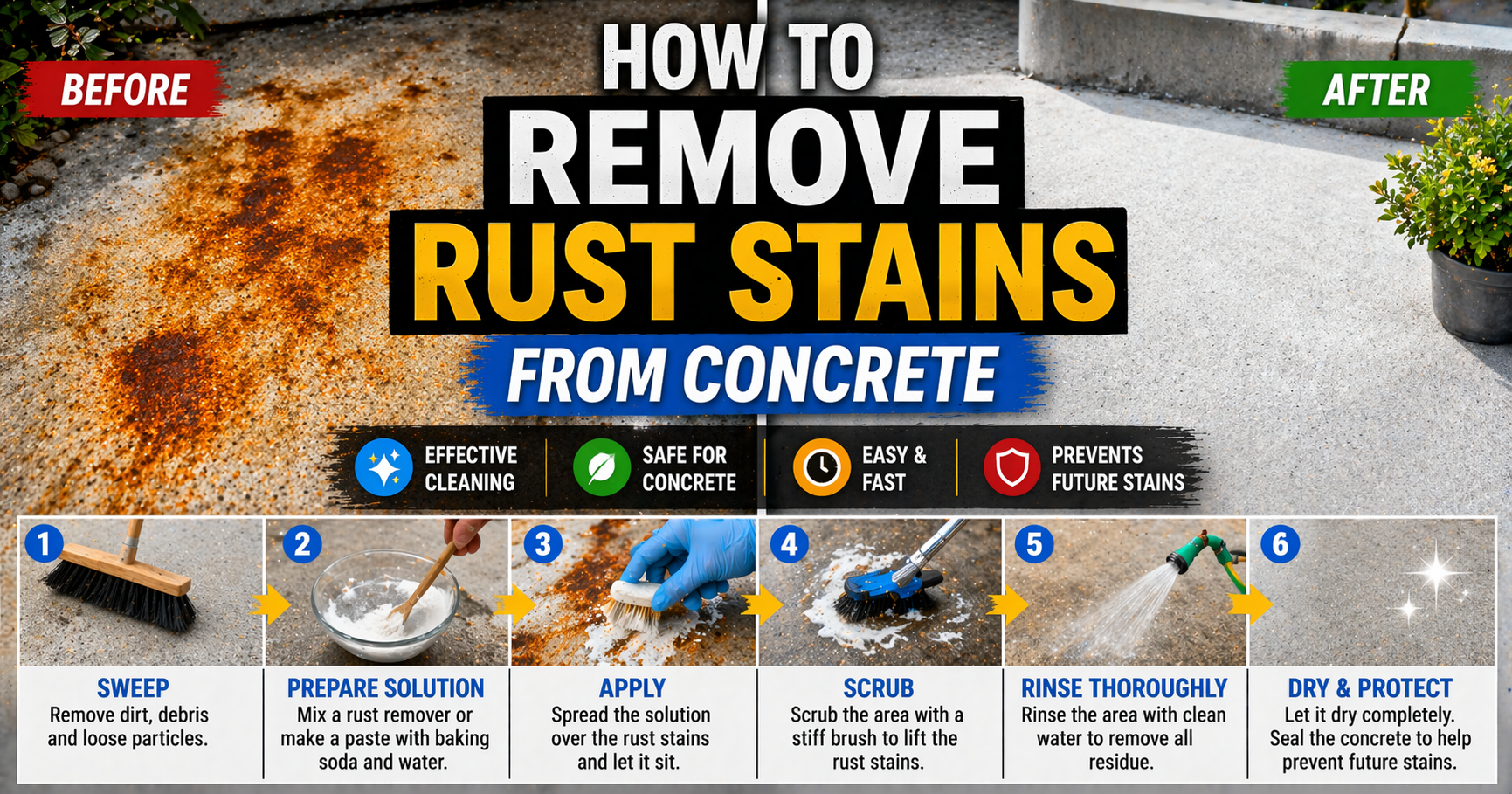
That orange stain spreading across your driveway, patio, or garage floor isn’t coming off with a garden hose and some scrubbing. Most people find that out the hard way. Removing rust stains from concrete requires a specific chemical approach because you’re not dealing with rust on metal, you’re dealing with iron oxide that has bonded directly with the porous surface of the concrete itself. Pressure washing shifts dirt. It doesn’t touch iron oxide. The wrong cleaner just spreads the stain further.
The right approach depends on how old the stain is, how deep it’s penetrated, and what caused it. This guide covers all of it.
Where Concrete Rust Stains Actually Come From
Before treating the stain, it’s worth knowing what put it there because if you don’t address the source, the stain comes back within weeks.
The most common culprits:
- Metal furniture and fittings – chair legs, table bases, barbecue stands, and plant pot holders sitting on concrete for extended periods. The rust leaches from the metal onto the surface below.
- Fertiliser runoff – many fertilisers contain iron compounds. When water carries them across concrete, they leave rust-coloured trails, often in fan patterns following drainage lines.
- Steel reinforcement (rebar) – in older concrete, corroding rebar beneath the surface causes rust to bleed through as brown staining, often with cracks radiating outward. This is a structural issue, not just cosmetic.
- Well water with high iron content – sprinkler systems and hose runoff leave distinctive arc-shaped staining where water hits the surface repeatedly.
- Nails, screws, and metal debris – left on concrete surfaces, they rust and transfer directly into the slab.
Rebar-related staining is the one case where cleaning alone isn’t the solution. The rust will return and worsen until the underlying structural issue is addressed. For everything else, you can get genuinely good results with the right chemistry.
Why Concrete Rust Stains Are Chemically Different
Scrubbing harder isn’t the answer here. Concrete is porous, and iron oxide particles penetrate into those pores and bond with the calcium compounds in the cement matrix. Mechanical action alone can’t lift them out.
What does work is a chelating agent a chemical that binds to the iron molecules and pulls them out of the concrete so they can be rinsed away. That’s what oxalic acid, citric acid, and purpose-built rust stain removers do. They don’t bleach the stain or mask it. They chemically extract the iron.
Counterintuitively, bleach makes concrete rust stains worse. Chlorine bleach oxidises the iron further, deepening and setting the stain rather than removing it. It’s one of the most common mistakes people make on driveways. Avoid it entirely.
Method 1: Lemon Juice or White Vinegar – For Fresh, Light Stains
Caught it early? Acidic household products can shift fresh rust staining before it penetrates deeply. Pour undiluted white vinegar or fresh lemon juice directly onto the stain, let it sit for 10–15 minutes, then scrub with a stiff nylon brush and rinse with clean water.
Don’t expect this to work on stains older than a few days or anything that’s had time to dry and set into the surface. The acid isn’t strong enough to extract deeply bonded iron oxide. It’s a first-response option, not a heavy-duty solution. Our guide on removing rust with vinegar explains why the chemistry works better on metal surfaces, but concrete is a different challenge.
Method 2: Oxalic Acid – The Most Reliable All-Round Treatment
Oxalic acid is the professional standard for concrete rust stain removal. It’s the active ingredient in most commercial products marketed for this purpose, and you can also buy it as a powder and mix your own solution often more economical for large areas.
Mix oxalic acid powder with warm water according to the product instructions (typically around 100g per litre). Wet the concrete surface first applying acid to dry concrete causes it to penetrate too quickly and unevenly. Pour or brush the solution onto the stain, let it dwell for 5–10 minutes, then scrub with a stiff brush and rinse thoroughly with water.
For old or deep-set stains, you may need two or three applications. Each round lifts more of the embedded iron until the stain is gone.
Honest limitation: oxalic acid can lighten the concrete around the stain slightly with repeated application. On coloured or decorative concrete, test on a hidden area first.
Free Rust Removal Guide
Get our complete step-by-step rust removal guide – covering every method, surface type, and product. Free to download.
Method 3: Citric Acid Powder – Gentler, Still Effective
Citric acid is milder than oxalic acid and less likely to affect the surrounding concrete colour. It works on the same chelation principle, binding to iron molecules and lifting them from the surface. Mix a concentrated solution (3–4 tablespoons per litre of warm water), apply generously, dwell for 15–20 minutes, scrub, and rinse.
It’s particularly good for rust staining from fertiliser or well water, where the iron contamination tends to be spread across a wide area rather than concentrated in a single spot. Spreading it across a large driveway is also cheaper with citric acid than with proprietary rust removers.
Comparing your main options
| Method | Best For | Strength | Risk to Concrete |
|---|---|---|---|
| Lemon juice / white vinegar | Fresh, light stains | Low | Very low |
| Citric acid powder | Wide-area staining, fertiliser runoff | Medium | Low |
| Oxalic acid | Most rust stains, including old/deep | High | Low-medium (test first) |
| Commercial rust remover | Convenience, severe staining | High | Low (pH-neutral formulas) |
| Pressure washing alone | Surface dirt only | None for rust | None |
| Bleach | Nothing – avoid entirely | Negative | Worsens staining |
Tackling Deep, Old Stains That Won’t Budge
Some stains have been sitting for years. The iron oxide has bonded deep into the concrete matrix, and a single treatment won’t lift it entirely. Here’s the approach that works for the worst cases.
Poultice method
Mix oxalic acid or a commercial rust remover with an absorbent material, such as diatomaceous earth, talcum powder, or even plain flour, into a thick paste. Apply it to the stain in a layer about 1cm thick, cover with plastic sheeting, and leave it for 24 hours. The poultice draws the iron out of the concrete as it dries, rather than just reacting at the surface. Remove, scrub, rinse, and repeat if needed.
This approach is slower but significantly more effective on stains that have penetrated deeply. It’s the same principle used for removing oil and chemical stains from concrete, using absorption to pull contamination out rather than just dissolving it at the surface.
Pressure washing after chemical treatment
Once you’ve done the chemical work, a pressure washer is genuinely useful for the rinse step. It drives the loosened iron particles out of the pores rather than leaving them near the surface where they can re-bond. Use it after the chemical treatment, not instead of it.
Preventing Concrete Rust Stains From Returning
Remove the source first. Lift metal furniture onto rubber or plastic feet. Fix sprinkler heads that are hitting concrete surfaces. Replace any rusting nails, brackets, or fittings. These steps do more than any sealer or coating.
For concrete you want to protect long-term, a penetrating concrete sealer applied after cleaning creates a hydrophobic barrier that significantly slows iron uptake from future staining. It won’t make the surface completely immune, but it makes future stains easier to remove because they haven’t bonded as deeply with the substrate.
If you’re dealing with rust problems across multiple surfaces, metal tools in the same workshop, garden equipment nearby, our guides on removing rust from metal tools and long-term rust prevention cover the full picture. Solving the rust at its source always saves more effort than repeated cleaning. The Ultimate Guide to Rust Removal brings all of these approaches together if you want the complete view.
The Rust Restoration Handbook
The complete professional reference for rust removal and metal restoration. Every technique, product, and process — in one handbook.
Clean Concrete Is Achievable — With the Right Chemistry
Rust stains on concrete look permanent. They aren’t — but they do require the right approach. Skip the bleach, skip the pressure washer as a standalone fix, and reach for oxalic or citric acid instead. Work with the chemistry, let the dwell time do its job, and address whatever caused the stain in the first place. Fresh stains clear quickly. Old ones take patience and repeat treatment. Either way, they come out.