Here’s something most people get wrong: rust isn’t just surface dirt you can wipe off. It’s an electrochemical reaction eating through your metal from the inside out — and by the time you can see it clearly, it’s already been working on you for a while. The good news is that rust removal is one of those skills where the right knowledge genuinely changes the outcome. Scrub blindly with the wrong abrasive on cast iron and you’ll do more damage than the rust did. Use the right converter on a car panel and you can stabilise damage that looked terminal. This guide covers everything — methods, tools, products, surfaces, and the honest trade-offs between them — so you can actually make the right call for your situation.
What Rust Actually Is (And Why It Matters for Removal)
Most people assume rust is just metal going brown. It’s not that simple. Iron oxide — which is what rust actually is — forms when iron or steel reacts with oxygen and moisture in a process called oxidation. The resulting compound is physically different from the base metal: it’s flakier, weaker, and critically, it’s porous. That porosity is what makes rust so aggressive. It lets more moisture in, accelerating the reaction further into the metal beneath.
Different metals rust differently, too. Steel rusts fast and aggressively. Cast iron is more tolerant but still very vulnerable. Stainless steel can develop rust stains from external contamination even though it resists oxidation itself. Chrome doesn’t rust but the steel underneath it does — and once pitting starts, you’re fighting on two fronts. Understanding this distinction shapes every decision about which rust removal method to use.
There’s also a structural dimension that changes your options. Surface rust and deep rust are fundamentally different problems. Surface rust — a thin, reddish-orange film — is genuinely just the beginning of oxidation. Deep rust has converted a measurable thickness of the metal itself into iron oxide. One you can treat chemically. The other requires mechanical removal or, in severe cases, replacement. Getting this diagnosis wrong is where most rust removal projects go sideways.
The Three Stages of Rust Progression
Think of rust in three stages. Stage one is surface oxidation — a thin, reddish layer that hasn’t penetrated the metal significantly. Stage two is active pitting, where the rust has begun to eat into the surface and you’ll feel texture changes even after cleaning. Stage three is structural rust, where the metal has thinned or become flaky to the point where its integrity is compromised. Stage one and early stage two are ideal candidates for chemical rust removal. Stage three often requires mechanical methods, professional help, or section replacement.
The honest limitation here: even experienced metalworkers sometimes misjudge the depth of rust until they start removing it. You may start a job expecting surface rust and find active pitting underneath. Build that contingency into your plan before you start.
Why Leaving Rust Untreated Is Never Neutral
Some people see a small rust spot and decide to deal with it later. That’s rarely a neutral choice. What happens when you leave rust untreated is a progression, not a pause — the oxidation continues, the pitting deepens, and what was a one-hour surface treatment becomes a multi-day metalwork project. On load-bearing structures, it becomes a safety issue. On vehicles, it becomes an MOT failure or structural failure. On tools and cookware, it becomes a hygiene issue. The rate varies by environment — coastal salt air accelerates rust dramatically compared to dry inland conditions — but in no environment does rust halt itself.
Rust Removal Methods: The Full Breakdown
Spend ten minutes searching for rust removal advice and you’ll find someone recommending everything from industrial chemicals to lemon juice. Not all of these are equally effective, and not all of them are appropriate for every situation. Here’s how the main methods actually compare — with their real trade-offs, not just the optimistic version.
Mechanical Rust Removal
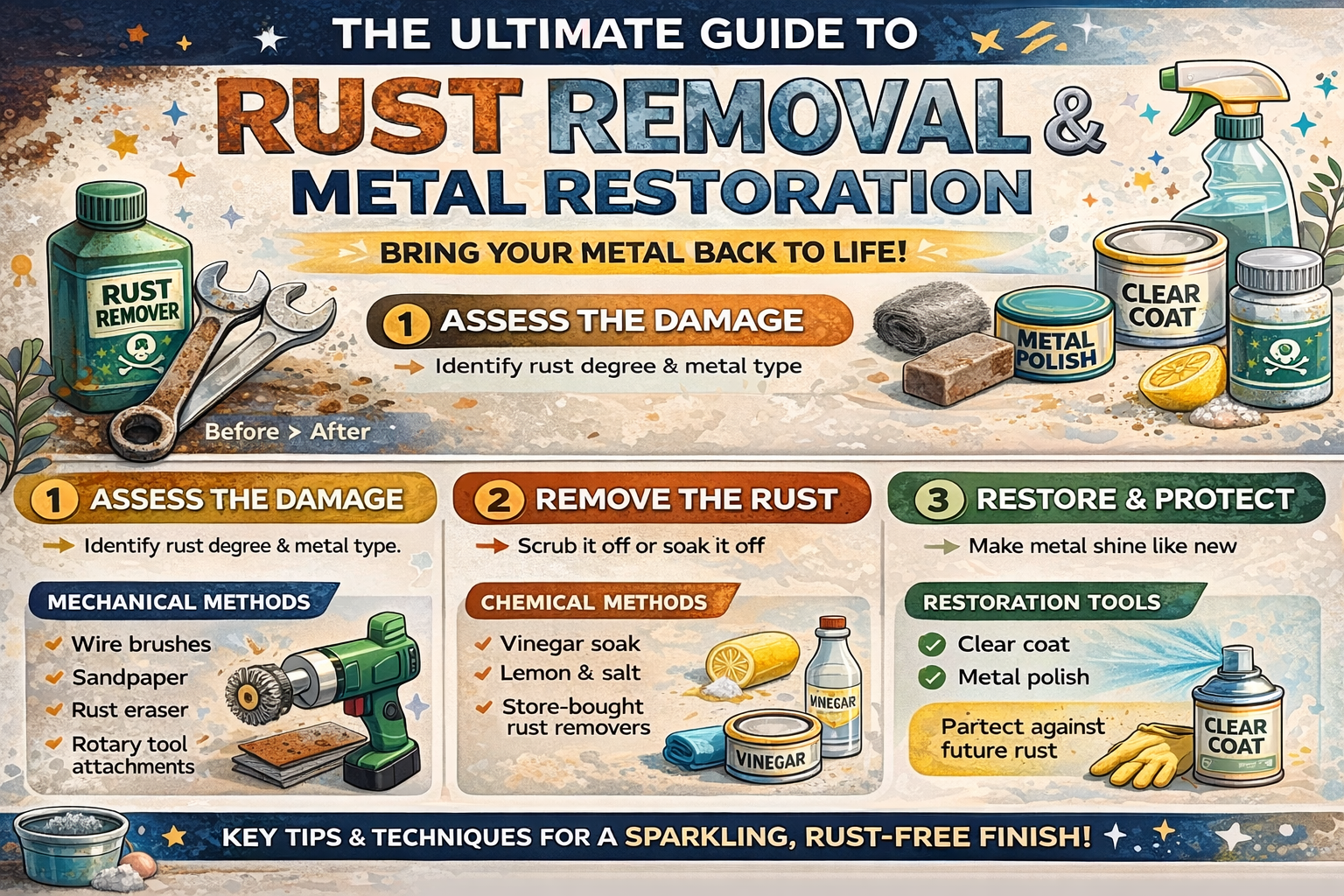
Wire brushes, angle grinders, flap discs, sandpaper, and abrasive pads — mechanical removal is the most direct approach. You’re physically abrading the rust off the surface. It works on almost any metal and any depth of rust, and it doesn’t require waiting for chemicals to react. For heavy rust and severe oxidation, mechanical methods are often the only realistic starting point.
The friction point: mechanical removal is aggressive. On thin metal, it’s easy to remove more material than you intended. On decorative or precision surfaces, scratching is a real risk. And on rust that’s in recesses, corners, or intricate shapes, abrasives can’t always reach. It’s also physically demanding and time-consuming on large surfaces. Use it where it makes sense — heavy structural rust, thick stock, preparation before painting — and not as your default for every job.
Chemical Rust Removal
Chemical removers work by reacting with the iron oxide and converting or dissolving it. There are two main types: rust dissolvers (usually acid-based, like phosphoric acid products) and rust converters, which chemically transform rust into a stable compound rather than removing it entirely. The distinction matters. A rust dissolver removes the rust but leaves bare metal that needs immediate protection. A rust converter turns the rust into a priming layer — it’s often the smarter choice on complex surfaces where complete removal is impractical.
Counterintuitively, stronger isn’t always better with acid-based removers. Very aggressive acids can etch and pit metal surfaces if left too long, creating a rougher surface than the rust itself left behind. Always follow dwell times precisely and neutralise properly after use.
Electrolysis Rust Removal
If you haven’t tried electrolysis, it’s worth knowing about. You submerge the rusty part in a water-and-washing-soda solution, connect it to a battery charger, and use a small current to reverse the oxidation process. It sounds exotic, but the results are genuinely impressive — particularly for complex shapes like cast iron cookware or intricate tool parts where mechanical abrasives can’t reach.
The full process and setup details are covered in the complete electrolysis rust removal guide. The honest caveat: it requires a setup and some patience — you’re looking at several hours minimum for heavily rusted parts. It’s also not practical for large items or anything you can’t submerge. But for the right application, it’s one of the most thorough methods available.
Natural and Household Methods
Vinegar, baking soda, lemon juice, potatoes with dish soap — these circulate online constantly. Some of them actually work, within limits. Vinegar removes rust because it contains acetic acid, which dissolves iron oxide. It’s genuinely effective on light to moderate rust with sufficient soak time. Baking soda works differently — it’s mildly abrasive and slightly alkaline, useful as a paste for scrubbing surface rust.
The evidence is mixed on how these compare to commercial products for serious rust. For light oxidation on knives, tools, or small cast iron items, they’re a solid option. For structural rust on a car or deep pitting on machinery, they’re not going to cut it. Using the right tool for the job isn’t just cliché — with rust removal, it’s the difference between a clean surface and a scratched, still-rusty one.
What About WD-40?
Almost everyone has tried it. WD-40 and rust removal is one of those topics where the product’s reputation has outrun its actual chemistry. WD-40 is a water-displacement lubricant, not a rust remover — though the company does make dedicated rust removal products in their specialist range that use different chemistry. The standard formula can help with very light surface oxidation and is useful for loosening rusted fasteners, but it won’t remove established rust the way a phosphoric acid product or chemical converter will. It’s also not a long-term rust preventative. Know what you’re reaching for before you reach for it.
Rust Removal by Surface: The Right Approach for Each Material
One method does not fit all metals. The same wire brush that’s appropriate on structural steel will ruin a seasoned cast iron skillet. The acid soak that cleans a bike chain beautifully will strip chrome plating. Getting specific about the surface you’re working on is one of the highest-leverage things you can do before starting any rust removal project.
Removing Rust from Cars and Vehicles
Vehicle rust is its own discipline. Removing rust from a car involves several distinct challenges that don’t apply to most other metalwork: the rust is often behind paint, it may affect structural components, and the repair has to hold up to ongoing weather exposure, movement, and vibration.
Surface rust on a car panel — the kind that’s just beginning to break through paint — is genuinely manageable at home. Sand it back to bare metal, treat with a phosphoric acid product to convert any residual rust, prime properly, and repaint. The job expands significantly if the rust has penetrated the panel thickness. Bubble rust (where you can see the surface bulging) usually means the metal behind is already heavily compromised. And structural rust — on sills, subframes, or floor sections — is a job where the safety implications make professional assessment worthwhile.
Before committing to a major rust repair on a vehicle, it’s worth asking whether removing the rust is worth it relative to the vehicle’s value. On a classic or sentimental vehicle, absolutely. On an older daily driver where the repair cost approaches or exceeds the car’s market value, that calculus is harder.
Removing Rust from Metal Tools
A rusted wrench or chisel is one of the most common rust removal scenarios, and it’s one of the most forgiving. Removing rust from metal tools usually involves a combination of soaking (in vinegar, citric acid solution, or a commercial rust remover) and light mechanical abrasion. For hand tools, electrolysis is particularly effective — the geometry of tool heads and handles is perfect for submersion treatment.
One scenario that catches people out: rusted tools with wooden handles. The soak approach works perfectly for all-metal tools, but soaking wood causes it to swell, crack, and potentially loosen from the metal. Remove handles before soaking, or use a gel-format rust remover that you apply and wipe without submersion.
Cast Iron Cookware
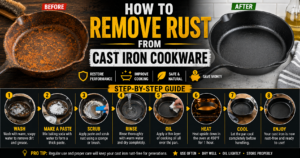
Cast iron is one of those surfaces where the wrong approach doesn’t just fail to fix the problem — it makes a new one. Cast iron rust removal has to account for the seasoning layer that gives the pan its non-stick properties and protects the iron from moisture. Heavy-handed abrasive work strips that seasoning entirely, leaving you with a clean pan that will rust again within hours if not immediately re-seasoned.
The standard approach for light to moderate rust on cast iron: coarse salt and half a raw potato (the oxalic acid in the potato helps), scrubbing with a stiff brush, then immediate drying and oiling. For heavier rust, electrolysis is the gold standard — it removes rust without abrading the surface texture. After any rust removal on cast iron, re-seasoning in the oven is non-negotiable.
Chrome Surfaces
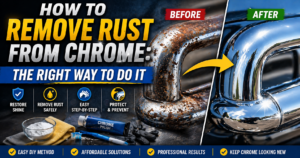
Chrome plating presents a specific challenge: the chrome itself isn’t rusting — it’s the steel substrate beneath it. Removing rust from chrome means you need to address rust without damaging or penetrating the plating. Aggressive abrasives are out — they’ll scratch the chrome and remove the very protection layer you’re trying to preserve. Fine steel wool (0000 grade), aluminium foil with water, and specialist chrome polishes are the appropriate tools. The aluminium foil method in particular is surprisingly effective: the electrochemical interaction between the aluminium and the rust lifts it without scratching the chrome.
Stainless Steel
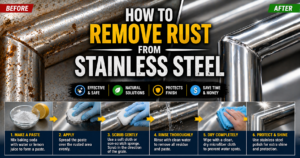
Here’s a common misconception worth addressing directly: stainless steel can rust. It’s more resistant than carbon steel because of its chromium content, which forms a passive oxide layer that self-repairs — but that protection isn’t unlimited. Contamination from iron particles, chloride exposure in marine environments, or mechanical damage to the surface can all lead to rust. Stainless steel rust removal requires non-chloride cleaners and non-abrasive or very fine abrasive tools. Avoid steel wool, which leaves iron particles that cause further rust. Baking soda paste and nylon scrubbing pads are often the right starting point.
Bike Frames and Components
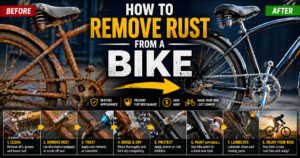
Bikes combine multiple materials and surface types in close proximity — steel frames, chrome parts, aluminium components, rubber seals — which means rust removal has to be targeted and precise. Removing rust from a bike usually starts with disassembly: you don’t want chain degreaser near rubber seals, and rust converter on a frame near an aluminium component can cause galvanic issues if not applied carefully. Light frame rust responds well to fine wire brushing followed by a phosphoric acid treatment and touch-up paint. Chain and drivetrain rust is often a sign replacement is more practical than restoration.
Knives and Blades
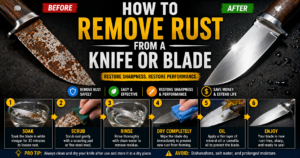
The metallurgy of knife steel adds a dimension most rust removal guides skip. High-carbon knives rust easily and quickly — that’s a property of the steel, not a flaw in the knife. Stainless knives are more resistant but not immune. Removing rust from a knife or blade has to account for the edge geometry — aggressive abrasives near the bevel can change the geometry you’ve carefully maintained. Cork and metal polish, a fine rust eraser, or a light acid soak followed by fine grit are the appropriate approaches. Then oil immediately after.
Concrete Rust Stains
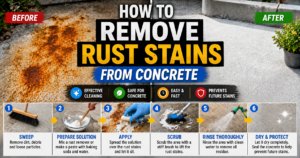
Not all rust removal is about the metal itself. Rust stains on concrete usually come from metal furniture, fixings, or tools left on the surface. The stain isn’t structural — it’s iron oxide that’s bonded to the concrete surface. Oxalic acid-based cleaners are the most effective treatment: they react with the iron oxide and lift it from the concrete without the aggressive bleaching that damages the surface colour or texture. Pressure washing alone rarely removes established rust stains.